


Once, people believed that myth and reality coexisted as one. Today, legends remain a tool—not to explain the world around us, but to help us better understand history. What was once worshipped is now repurposed into characters for fiction, redesigned to fit the modern mind.
Then and now, our core approach remains the same. We tell stories about human nature, even as time changes our relationship with the past. In the past, artists created what they believed. Today, we draw how we feel. What was once deeply believed is now breathed into a different form—one of feeling rather than faith. And somewhere between the two, a truth remains.
A leogryph looks different from a gryphon. Leogryphs are winged, lion-like guardians rooted in Asian mythology. Upon this creature's back sits a yakshi, the spirit of fertility and watchful abundance. Beneath them are smaller elemental attendants one of earth and one of water representing the forces that sustain daily life.
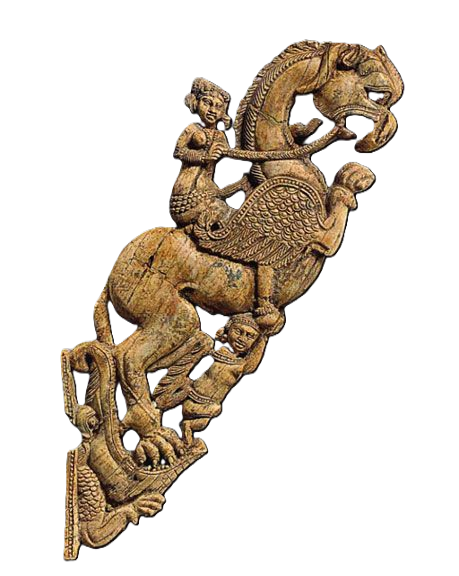
From a folklorist's perspective, this ivory carving can be understood as a story of balance. Earth without water becomes barren; water without earth becomes wild. Believing in spirits made sense to ancient people because it explained how nature's forces stayed in harmony—where one force guards, another guides, and a third restrains. Even as a decorative object, it holds a profound story: every gift in the world is paired with a cost, every blessing with a duty, and every element with its counterpart. Even spirits can grow tired of their duty and choose to switch paths. When they do, stories tell us of the chaos that follows such a decision. While spoken words and written stories fade over time, visual tales endure much longer. Once, we know the meaning of elements, meaning becomes clear: balance is easily disturbed, and if even a single element goes missing, the entire composition falls apart.
Tomyris was a historical figure, born of the steppe winds. Better recognized as the queen of the Massagetae tribes, she had to unite fierce nomadic clans who lived across the open Central Asian plains, forming an army of fierce steppe riders. What can be told about gryphons? Well, they were used as sigils on traders' marks, and they can often be found over houses of art and music. But a few stories intrigue us more. Gryphons were protectors of caves where treasures beyond human imagination were hidden. They were protectors of cliff cities and fierce hunters, depicted and revised throughout antiquity. But what about a gryphon's allowance to be ridden? A gryphon is a creature that does not bow to royal lineage; it looks straight through a person's heart, tearing apart those with ill intentions while allowing those with an honorable purpose to pass. It is known through the rider's experience, having a bond built on the light senses between a horse and a rider. They feel one another through movement and thought. By redefining the classic bond of the rider. Queen and gryphon stand together as one—a protector and the protected, united by a raw freedom over the protection of their homeland. History and fiction, merged in to the dynamical revision. Her ancient sovereignty into a modern visual story.
The story of Tomyris, queen of the Massagetae, survives only in fragments. She is best known through Herodotus, who preserved the most dramatic version of her life ruling a confederation of steppe tribes. Her people were proud riders of the open plains, fierce in battle, loyal in kinship, and bound to the sun god who watched over the steppes. Historically, they could be distinguished by the striking gold jewelry worn on their headsets, shoulders, and belts. Her most famous chronicle tells of a massive battle against Cyrus the Great, the conqueror of Lydia and Babylon. Cyrus tried to take her lands first through a proposal of marriage, and then through a brutal invasion. When his deceptive wine trap led to the tragic death of her only son, Spargapises, Tomyris was driven by a mother’s grief and a queen's duty to protect her people. She swore an oath to the sun that she would give Cyrus his fill of blood. In the final battle, she fulfilled it, defeating the greatest king of her age. While every story holds only a part of the truth, the historical impact is undeniable: in Greek storytelling, her victory became antiquity’s most enduring image of a woman who refused to submit.
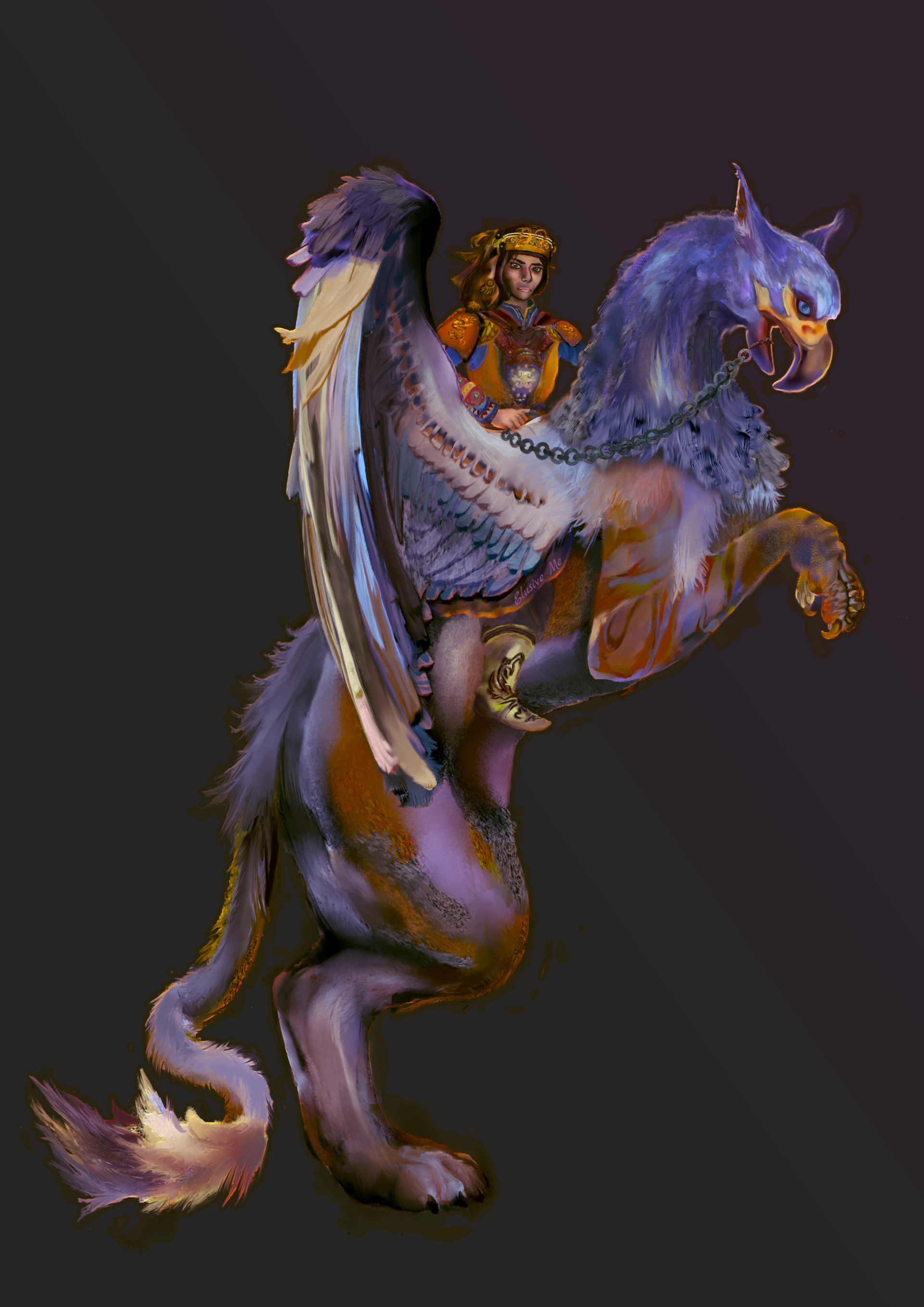
The specific colors of the gryphon’s coat and its chain bridle are heavily inspired by the novel Dragon Age: Last Flight. In the book's final arc, we were given the hopeful thought of gryphons returning to Thedas after the events of the Fourth Blight. Upon playing Dragon Age: The Veilguard, that hope became a reality, and gryphons truly roam Thedas once again.