

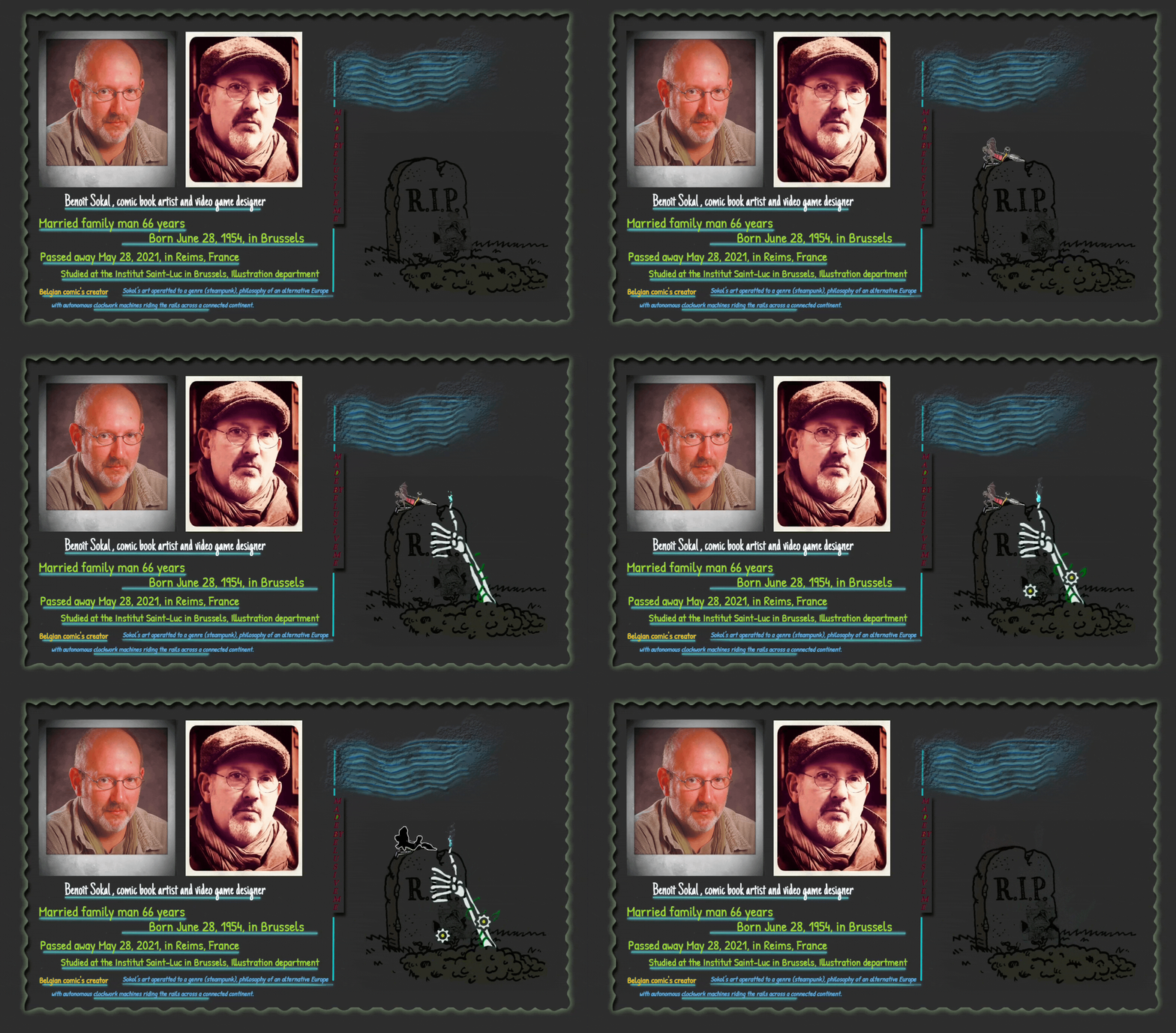
Benoît Sokal - Honoring a Memory of a teacher
Artist of unique_Protagonists
Author of Adventurers :Who Grew through their travels
To deepen Atmosphere
⇩
Benoît Sokal was born on June 28, 1954, in Brussels. He passed away after a long-term illness on May 28, 2021, in Reims, France, where he had lived for many years, at the age of 66. His wife, Martine, ran the BD-Bulle comic store and gallery in Reims. His son, Hugo, collaborated with his father on comic scripts and also wrote a comic book adaptation of the Syberia game series. People live by a certain purpose that each of us must find. For some, life is defined by their work, for others, it is measured by what they leave behind. Yet what matters most? In games, purpose isn’t always about reaching a specific goal or witnessing someone else’s triumph. It is about the adventure—the journey we make, that truly matters. Not all of us are fortunate enough to live a journey of a lifetime. The real world does not always offer the points of interest we desire. Yet, just as someone can leave behind ideas through their art, Sokal gifted us a legacy—a vision of untold but possible future perspectives of the world. By reshaping simple everyday mechanics into something unbelievable, he reminds us of what imagination can achieve. Even when reality feels limited, imagination can open doors to journeys we never thought possible.
Speaking of his childhood and future involvement in an illustrator’s career, he was fortunate to grow up in an intellectually rich environment. His father served as a dean at the Faculty of Medicine and Health Sciences at the University of Leuven, while his mother worked as an orthodontist.
He and his four siblings often spent time in their mother’s waiting room, where shelves were filled with comic magazines such as Tintin, Spirou, and Le Journal de Mickey. These early readings planted the seeds of inspiration for the young artist. Over time, his creative vision was further shaped by the works of masters like Hugo Pratt, René Hausman, Robert Crumb, and André Franquin—figures whose influence helped guide him toward his own distinctive style and eventual career in comics and video games.
While studying to become a veterinarian at Notre-Dame de la Paix in Namur, Benoît found greater joy in drawing comics for the student magazine. In 1973, he began new studies at the Institut Saint-Luc in Brussels, initially enrolling in the Illustration department. His former teacher, Claude Renard, was training a new generation of comic artists in his renowned Atelier R. Renard encouraged his pupils to experiment and develop their own personal styles. Thanks to the support of Walloon Minister of Culture Jean-Maurice Dehousse, student works were granted publication. The first two issues of the student magazine featured some of Sokal’s realistically drawn comics and animal illustrations. Sokal always remained respectful and grateful to Renard for his guidance.

He was also one of the fortunate students to secure a steady job before graduation. In 1977, Didier Plateau, head of the comic publishing company Casterman, visited Saint-Luc in search of new talent. Impressed by Sokal’s striking animal drawings, Plateau selected him among the promising artists. Plateau was preparing to launch a new monthly adult comic magazine, and Sokal’s work was chosen to be featured. That same year, Sokal debuted his first professional comic series: Une Enquête de l’Inspecteur Canardo, usually shortened to L’Inspecteur Canardo or simply Canardo.
Benoît became one of the foremost Belgian adult comic creators through his contributions to (À Suivre) magazine in the late 1970s. One of the earliest works quickly became well known among fans and brought him fame. A sleazy, down‑on‑his‑luck, a depressed anthropomorphic duck, gritty yet humorous anti‑hero Inspector Canardo (1978–2018). Detective, whose vices included cigarettes, alcohol, and femmes fatales. At first Canardo conceived as a parody of popular crime fiction and noir movie genre, Inspector quickly grew beyond its genre roots.
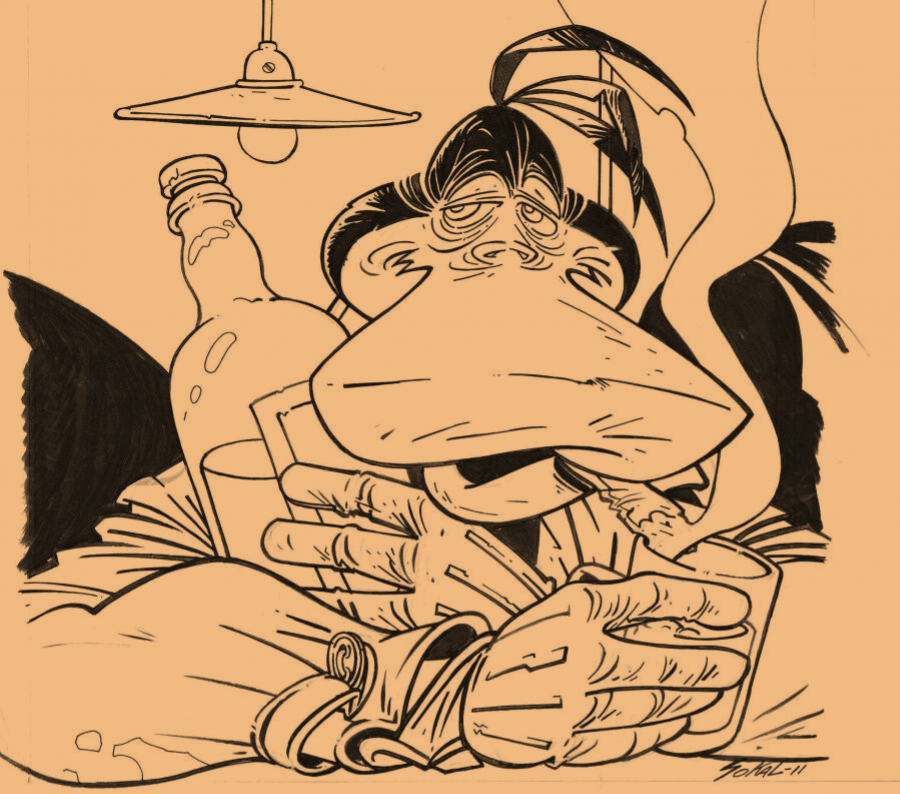
Sokal crafted an atmosphere of crime thrillers set in a depraved, anthropomorphic animal world, lightened by black comedy and sharp satire.


His mastery of drawing animals—was evident not only in Inspector Canardo but also in his other comic projects, including:
- Sanguine (1988) Set during the Thirty Years’ War (1633) in the Holy Roman Empire, a time of religious conflict between Catholics and Protestants


- Silence, On Tue (1990)


- Le Vieil Homme Qui N’Écrivait Plus (1996) A story set in the world of cinema, infused with crime and noir atmosphere. An actor is found strangled on a film set, and the reader must piece together the clues to uncover the murderer.


- Kraa trilogy (2010–2014), a dark, ecological revenge tale set in land resembling Alaska or Siberia, where a telepathic bond between a boy and a black eagle drives a struggle against human exploitation of nature.


- Aquarica Created in cooperation with François Schuiten in 2017, was originally conceived as an animated film, but after years of development difficulties it was eventually retold as a comic book—a naval fantasy about a hidden oceanic world carried on the back of a giant whale, where ecological and mythic storytelling intertwine.


“All new is just the well‑forgotten old”—and so it was with the inspiration for Inspector Canardo. In interviews, he revealed that one of his satirical influences came from Edmond‑François Calvo’s La Bête est Morte, a comic book in which animals serve as metaphors for nations and personalities during World War II. Similar satirical traditions could be found in Warner Brothers’ cartoons or in British newspapers of the era. Moving beyond satire, Benuit also drew inspiration from literary figures such as Ernest Hemingway and Jack London. Both authors shaped his imagination in youth, with Hemingway being particularly notable for stories retold from the perspective of animals. From the detective and noir tradition, Sokal found further influence in Raymond Chandler’s writing and in the films of director R.W. Fassbinder, whose atmosphere of stillness and tension resonated with his own creative vision.
It is a shame that none of the comics created by this Belgian artist have been translated into English. I have long wished to read a collected volume of his stories, especially Kraa, though I would also like to peek into the story of Sanguine, but the language remains a barrier to wider recognition—not only for me, but for many others. It feels almost unfair: if you want to study in France, you must learn French; if you want to read French publications, you must learn French. Since no one seems concerned with what outsiders may think, you are eventually forced to accept it. What a disaster for those who yearn to experience these works but are held back by language. Perhaps, though, this is part of the challenge or even the goal that art demands. To truly enter another world, sometimes we must cross the threshold of its language.
Before taking the decisive step into the video game industry, it is important to add another segment to his career in comic art.
Inspired by juvenile U.S. adventure novels by Jack London, Jim Harrison, and J.O. Curwood, he conceived the idea for the character Kraa while he was a student. Originally envisioned as a video game project, Kraa was later transformed into a comic due to insufficient funding. Although Sokal had been coloring his comics digitally since 1994, he chose to return to traditional tools—paper, pencil, and pastel—for this project. In his view, Kraa was an evocation of nature as a “lost paradise,” a secret, fascinating, and frightening world whose keys humanity had lost over the centuries. His decision to continue telling stories through the visual art of illustrated pages came from a heartfelt passion: the desire not to abandon what made him truly happy in his creative work. Kraa was eventually released as a graphic novel in 2010. Seeking new creative paths, Sokal later joined with his friend François Schuiten to develop the Aquarica universe. Initially attempted as an animated film, the project was ultimately realized as their graphic novel in 2017
Now that this is out of the way, let’s dive into the video game industry—his alternate worlds, which took an inseparable step from his comic works, but it will unfold in its own time.
Being among the early adopters of digital drawing and coloring techniques, in 1994 he became one of the first comic artists of his generation to color his stories with the help of a computer. To him, the difference between comics and video games was minimal, since both relied on similar narrative rules.
In 1996, Sokal joined the video game developer Microïds as a designer and later art director, traveling frequently between France and the company’s Canadian division.
Sokal always managed to set his characters in fictional countries that echoed real-world locations. L’Amerzone (1999) was his first creation—a fictional South American nation whose name plays on both the Amazon and the French word amertume (“bitterness”). Its campaign was inspired by an expedition from his Canardo comics. To make the game accessible to players unfamiliar with his original work, the plot was adapted into game design with the help of software engineer Gregory Duquesne, while comic writer Benoît Peeters briefly contributed. Unlike the comics, which often featured a group of characters, the game centered on a single protagonist, reinforcing its narrative focus.
L’Amerzone earned both critical and commercial success. His next work, Syberia (2002), became a landmark title for Microïds and secured its place among the point‑and‑click classics.
In August 2003, Benoît Sokal and his Microïds colleagues Olivier Fontenay, Jean‑Philippe Messian, and Michel Bams founded their own video game company, White Birds Productions. Before embarking on the studio’s first independent project, Sokal released Syberia II (2004) at Microïds, a sequel that confirmed his mastery of narrative‑driven adventure games and further established the series as a point‑and‑click classic.
In collaboration with Micro Application and Ubisoft, White Birds Productions’ first game was Paradise (2006). The original edition was accompanied by a companion comic book by Sokal, Lost Paradise of Maurania. Its plot follows the jungle journey of the daughter of an African dictator, who suffers from amnesia after her plane is shot down by rebels. The game also inspired a spin‑off comic series, Paradise (Casterman, 2005–2008), written by Sokal and illustrated by Brice Bingono.
White Birds’ next game, L’Île Noyée (Sinking Island: A Jack Norm Investigation, 2007), follows a police officer investigating the death of a millionaire. The action unfolds in an Art Deco‑style tower on a fictional island.
Alongside its main projects, White Birds Productions also developed video games based on literary classics. Martine à la Ferme (Emma at the Farm, 2006) and Martine à la Montagne (Emma at the Mountain, 2007) were adaptations of Gilbert Delhaye and Marcel Marlier’s Martine children’s books, while Nikopol: La Foire aux Immortels (Nikopol: Secrets of the Immortals, 2007) was based on Enki Bilal’s Nikopol graphic novels.
Unfortunately, due to financial difficulties, White Birds Productions closed in December 2010.

After Sinking Island, nearly ten years passed before Syberia 3. That pause was marked by the closure of the White Birds Productions studio, smaller adaptations of comics and children’s books, and a long period of uncertainty before Sokal returned to Microïds to revive Syberia. Those years were turbulent, with financial struggles, shifting technology, and the adventure genre itself losing ground before its eventual revival.
Kate Walker’s arc was complete—she had fulfilled her duty and could have returned to her life in New York. Most players likely believed her story had ended thirteen years earlier, but fate had different plans in store. Syberia 3 felt restless; times had changed, we had changed, and so its purpose had to change as well. Kate was once again struggling to decide what to do with her life, ultimately forced to face another turning point.
In truth, we all eventually find ourselves in similar positions. Someone will always tell us what we “must” do, yet we hesitate, lost in our own thoughts. The game reflected that same sense of self‑loss—an uneasy state of mind and soul—whether for better or worse. But one thing is clear: without that transition, we would never have The World Before in the form we came to know it.
And we have finally come to the last title, Syberia: The World Before (2022). Who knows if there will ever be a sequel, but what matters most is the beauty of Vaghen, the conclusion of the story, and the way it opened new paths for life. By the end of Kate’s journey, we can openly say she found a better plan—not to leave Europe just yet. Returning to New York would have meant only a more gruesome life than the one she had already endured; being enslaved in mines under Russian communists is hardly a perspective of life to wish for.

We all have different viewpoints in life, and that is as it should be. If there were a single correct answer to every problem, there would be no conflicts, fewer addictions, and fewer trials of war to endure. Yet if life always offered only one correct answer, it would be boring to live in.
I believe Kate understood that in life there is no easy step. The easiest choice would have been to give up and return to New York, but that would not have been interesting. It may seem irresponsible, yet what else is life if not small parts of a greater canvas, needing to be joined together to reveal the whole picture?
"L’essentiel est invisible pour les yeux." - What is essential is invisible to the eyes.

In conclusion, I wish to say T.H.A.N.K. Y.O.U., Yūgen, for being with us. Your work will continue to honor the memory of a man who has passed away, yet who remains alive through his art.